Almost everyone freezes the first time they see a red light. Your voice sounds strange, you don't know what to do with your hands and suddenly you forget what you knew. It's normal, and there's a fix.
⚡ In 30 seconds
- Fear is a natural reaction, and you can work on it.
- Prepare the ideas, not a memorised speech.
- Warm up your body and voice, and talk to a single person.
- Record often: every take gives you more confidence than theory.
Where does the fear come from?
In front of a microphone you feel judged. You know it will be recorded, that it can be played a thousand times and that any slip will be permanent. Your body reads this as a threat: your heart races, your breathing gets shallower and your voice tightens.
It's not a personal flaw. And like any reaction, it can be redirected. Swap "I have to get it perfect" for "I'm going to have a conversation with one person".
Master the topic, not the text.
Prepare the content, not the speech
A lot of nervousness comes from not being sure what to say. A running order with the main ideas gives you confidence. Memorising every sentence, on the other hand, means you fall apart the moment you forget a line.
If you know what you want to say and in what order, the words come on their own.
A good approach is to write five or six keywords, one per idea, on a card. If you lose your thread, glance at the card, breathe and pick up again. Nobody listening knows what was coming next, so a change of order goes unnoticed. There's a practical guide in how to structure a podcast episode.
Warm up your body and voice
Just as athletes warm up before competing, your voice needs warming up too.
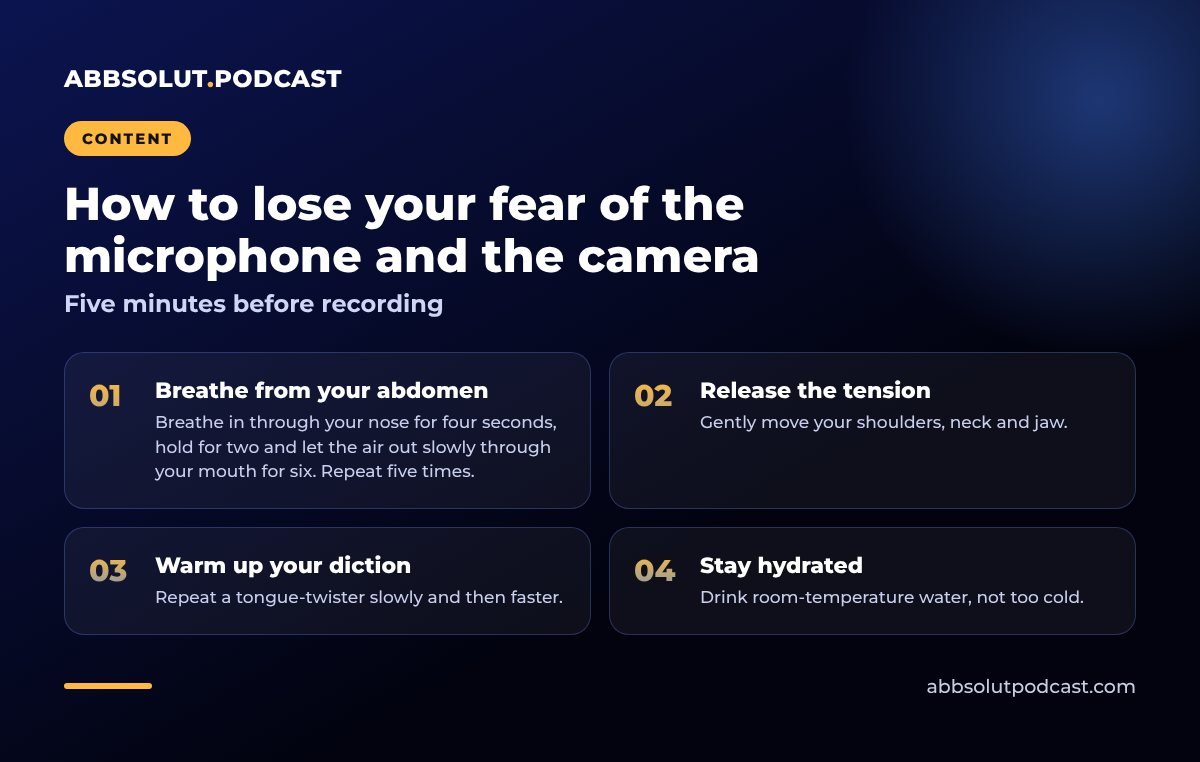
Five minutes before recording
- 01
Breathe from your abdomen
Breathe in through your nose for four seconds, hold for two and let the air out slowly through your mouth for six. Repeat five times.
- 02
Release the tension
Gently move your shoulders, neck and jaw.
- 03
Warm up your diction
Repeat a tongue-twister slowly and then faster.
- 04
Stay hydrated
Drink room-temperature water, not too cold.
Talk to one person, not an audience
This is the most useful shift in mindset. Instead of thinking of thousands of listeners, picture one specific person, a friend or a client, sitting on the other side. Talk to them as you would in a normal conversation.
💡 Tip
On video, look at the lens as if it were that person's eyes. If you find it hard, stick a note or a photo of a friendly face next to the camera. It sounds simple, but it works.
Use your body and voice
On video, body language communicates as much as words.
Five quick tweaks
Open posture
Back straight, shoulders relaxed and arms uncrossed.
Natural gestures
Use your hands as you would when talking to someone, without exaggerating.
A genuine smile
It comes through even on audio: your voice sounds warmer.
Measured pace
Nerves make us talk fast. Pause deliberately.
Varied tone
A flat voice is boring. Use volume and pace to emphasise what matters.
Record, listen back and repeat
At first, hearing yourself feels awkward: we're not used to hearing our own recorded voice. The best cure is exposure. Record two- or three-minute test takes, listen back and note one thing to improve and one thing that went well.
🎯 Example
Don't compare yourself to professionals with years of experience. Compare yourself to your recording from last week. You'll see you're progressing faster than you imagine.
To fine-tune your mic position and surroundings, see how to record a podcast at home.
A ritual and a plan for mistakes
Rituals are calming. Always follow the same sequence: check your running order, breathe, drink some water, check the sound and say your first sentence aloud. Over time, your body will learn to read it as a cue to relax.
It works just like an athlete's routine before a match. It doesn't get rid of nerves completely, but it channels them where they help you: into energy, not into freezing up. And remember that a few nerves come across as enthusiasm, which draws people in.
⚠️ Watch out for this
A stumble, a filler word or a silence isn't a disaster. It can be edited out, as you'll see in how to edit a podcast. Breathe, repeat the sentence and carry on. Listeners often appreciate that natural feel.
What if you need a nudge?
Executives, therapists, teachers and entrepreneurs with plenty of experience, but little in front of the camera, often benefit from some coaching beforehand. Working on confidence, body language and message helps them communicate authentically.
Nacho Encinas, founder of Abbsolut Podcast, has more than fifteen years' experience in communication and has trained over 1,200 professionals. You can read more about his career at nachoencinas.com.
In short
Fear is normal and you can work on it. Prepare your ideas, warm up, talk to one person and record often.
A fun, pressure-free way to try it is to step onto a podcast set at a trade show or celebration. We talk about it in a podcast set on your stand and a podcast at your wedding.
🎙️ How we do it at Abbsolut
If you'd like our help before recording, our on-site training sessions work with you on voice, camera and message. And as a podcast production company in Barcelona, we can also handle the recording.
Would you like us to produce your podcast?
We're a podcast production company in Barcelona. Tell us your idea and we'll send you a no-obligation proposal.
Get a quote