Everyone has something to say, but few know where to start. Launching a podcast seems daunting until you break it down into small steps. Here's the whole process, from idea to first published episode, exactly as we do it in our work as a podcast production company in Barcelona.
⚡ In 30 seconds
- Purpose first, microphone second.
- A specific topic and a format that feels natural to you.
- Take care of the sound and record a few episodes before publishing.
- Publish via a hosting service and RSS feed, and promote from day one.
Work out why you want to make a podcast
Before buying anything, answer three questions: what you want to achieve, who you're talking to and what sets you apart. A podcast for your personal brand is planned differently from one to train your clients or one to share a passion.
If you're not sure, sum up in one sentence what someone should feel or learn by the time they finish listening. That sentence will be your compass for tone, length, guests and even the name.
With a clear purpose, everything else is easier.
Choose the topic and format
The topic should be specific enough for people to know whether it's for them, and broad enough to record dozens of episodes without repeating yourself. The format depends on what you're comfortable with: monologue, conversation, interviews or narrative.
We've devoted a whole article to this decision: how to choose the topic and format of your podcast.
💡 Tip
If you're torn between several formats, record a test episode of each and go with the one that feels most natural.
Get the essential equipment
You don't need a studio. All you need to start is a good microphone, closed-back headphones and a quiet space. Sound quality is what listeners value most, even more than content: people abandon annoying audio within seconds.
The basics to get started
Microphone
A dynamic USB mic to start with, or an XLR mic with an interface if you want to upgrade later.
Closed-back headphones
To monitor what you're recording.
An echo-free space
A room with curtains, a rug and books helps a lot.
You'll find the details in what equipment you need to record a podcast and in how to record a podcast at home with good sound.
Structure, record and edit
Improvising rarely works. A running order gives you confidence and pace: an opening that grabs attention, two or three clear ideas and a close with a call to action. It's all in how to structure a podcast episode.
If you're going to interview, prepare the questions and the silences too: how to prepare an interview for your podcast.
Record a few episodes before you publish the first one. You'll gain confidence and have some content in reserve. Then comes the editing: remove background noise, filler words and long silences, add music and balance the volume.
⚠️ Watch out for this
Editing isn't about covering up bad audio; it's about polishing audio that's already good. Get the recording right from the start.
When you get to that stage, we have two guides: how to edit a podcast and mixing and mastering.
Design your identity: name, artwork and music
Your name and artwork are your shop window. They need to be easy to read on a phone, memorable and right for your topic. Intro music and stingers add personality, but only use licensed music.
See how to choose your name and artwork and music and stingers for your podcast.
Publish and promote
Your podcast needs a hosting service that generates an RSS feed. You use that link to submit it to Spotify, Apple Podcasts, iVoox, YouTube and other digital platforms. You upload episodes in one place and everything else updates automatically.
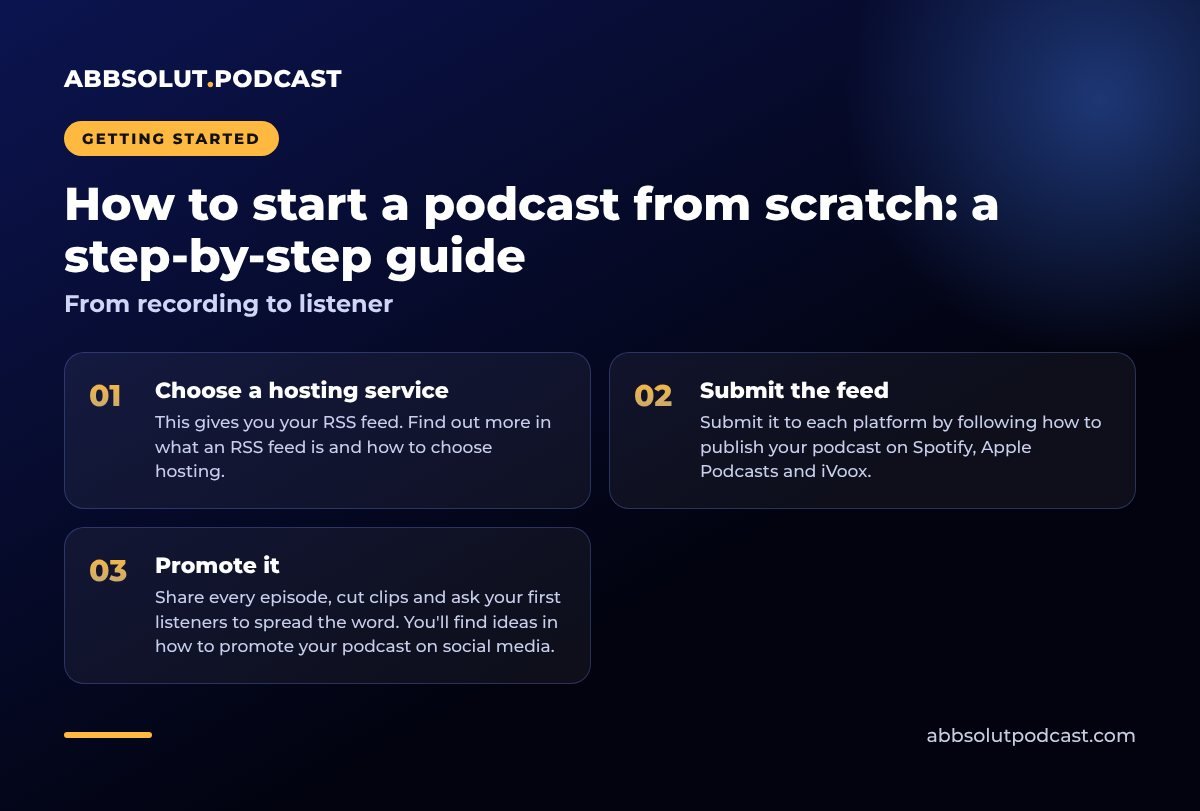
From recording to listener
- 01
Choose a hosting service
This gives you your RSS feed. Find out more in what an RSS feed is and how to choose hosting.
- 02
Submit the feed
Submit it to each platform by following how to publish your podcast on Spotify, Apple Podcasts and iVoox.
- 03
Promote it
Share every episode, cut clips and ask your first listeners to spread the word. You'll find ideas in how to promote your podcast on social media.
Publishing isn't the end, it's the beginning.
Common mistakes when starting out
Having worked with lots of projects, we see the same mistakes again and again:
- Trying to cover too much. A podcast that talks about everything speaks to no one. It's better to choose a specific topic and explore it in depth.
- Neglecting the sound. Brilliant content with echo loses listeners within the first minute.
- Having no schedule. Consistency matters more than perfection. Choose a realistic frequency, weekly or fortnightly, and stick to it.
- Giving up after three episodes. Podcasts grow slowly. Results come from consistency and word of mouth.
✅ Before you hit record
- I can sum up my purpose in one sentence.
- I know who I'm talking to.
- I've tested the format with a pilot episode.
- My room has no echo or background noise.
- I have a frequency I can keep up.
In short
Starting a podcast is a process, not a leap: purpose, topic and format, good sound, a script, careful editing, hosting and promotion.
And if you want people to find you from day one, have a look at how to make your podcast appear in AI search engines.
🎙️ How we do it at Abbsolut
If you'd rather leave the technical side to someone else, Abbsolut Podcast takes care of it for you, from start to finish. We're a podcast production company in Barcelona and we'll be with you every step of the way, from the first idea to publication.
Would you like us to produce your podcast?
We're a podcast production company in Barcelona. Tell us your idea and we'll send you a no-obligation proposal.
Get a quote