A well-structured episode is easy to listen to. Listeners know where they are, what they're going to get and why it's worth sticking around. One without structure rambles, repeats itself and loses its audience. And you don't need to be a writer to structure an episode: a few guidelines will do.
⚡ In 30 seconds
- A detailed running order for most projects, with the opening and close written out.
- Four parts: hook, introduction, body and close.
- Just a few ideas per episode: three is better than ten.
- Write for the ear and use a reusable template.
Script or running order: which do you need?
They're two different tools for different formats.

Two tools
Full script
You write out word for word what you're going to say. Useful for narrative shows, carefully crafted monologues or corporate content where the message has to be precise.
Running order
A list of points setting out the ideas and their order, without fixed wording. Ideal for conversations and interviews, because it keeps things natural.
For most projects, we recommend a detailed running order with the opening and close fully written out. Those are the two moments where improvisation shows most.
The basic structure of an episode
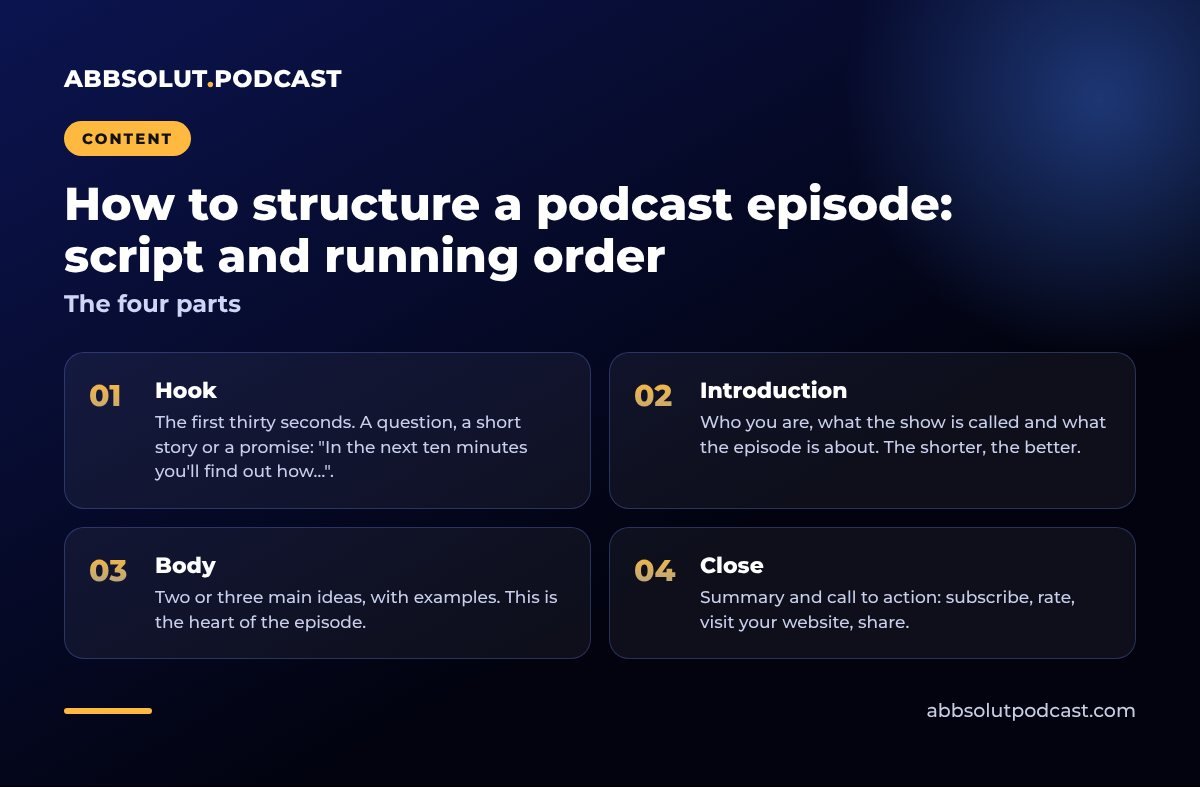
Every show is different, but almost all good episodes share four parts:
The four parts
- 01
Hook
The first thirty seconds. A question, a short story or a promise: "In the next ten minutes you'll find out how…".
- 02
Introduction
Who you are, what the show is called and what the episode is about. The shorter, the better.
- 03
Body
Two or three main ideas, with examples. This is the heart of the episode.
- 04
Close
Summary and call to action: subscribe, rate, visit your website, share.
This outline works just as well for a ten-minute episode as for an hour-long one.
How to write a hook that works
Listeners decide within seconds whether to stay. Four formulas that work:
- The direct question. "Have you ever wondered why…?"
- The mini story. A thirty-second anecdote that introduces the topic.
- The surprising fact. A figure or statement that sparks curiosity. Make sure it's true and verifiable.
- The clear promise. Tell listeners what they'll gain if they keep listening.
⚠️ Watch out for this
Avoid opening with twenty seconds of generic greetings or thank-yous. That can come later.
One idea per section
Each section should answer a question and end with a conclusion. A very useful pattern is statement, example, application: you state the idea, illustrate it with a case and explain how to use it.
🎯 Example
Statement: "A short hook keeps more listeners". Example: a thirty-second anecdote that grabs attention. Application: write your opening last, once you know what you're covering.
Don't cram ten ideas into one episode. Listeners struggle to remember more than three. The rest can become another episode, and that way you'll have plenty of material for your content calendar.
Better three ideas people remember than ten they forget.
Pauses and pace
A script isn't just words: it's also about breathing. Mark the pauses, changes of tone and points where music or sound effects come in on your running order. Changes of pace keep people's attention.
If you'll be recording interviews, plan your questions and your silences. You'll find specific techniques in how to prepare an interview for your podcast.
Write for the ear, not the eye
Text written to be read sounds stiff when spoken aloud.
✅ How to make your script sound natural
- Short sentences and active verbs.
- Read it aloud as you write it.
- No long paragraphs or chains of subordinate clauses.
- Repeat key ideas: listeners can't skip back and reread.
- Explain acronyms or leave them out.
A reusable template
A template saves you a lot of time. Create a document with fixed sections: hook, introduction, main points, close, links and show notes. Each week you simply fill it in, and listeners appreciate the consistency.
Add a section for production notes: which music goes where, which resources are mentioned and what needs to go in the description. It makes editing much easier, which we cover in how to edit a podcast.
Common structuring mistakes
- Not saying what the episode is about. Listeners need to know early on what to expect.
- Taking too long to get to the point. If the useful part only starts at minute five, many listeners will already have gone.
- Ending without a call to action. You miss the moment when listeners are most engaged.
- Neglecting transitions. Phrases like "now that we've covered this, let's move on to…" help give the episode structure.
💡 Read, record and adjust
No structure is set in stone. Listen back to the episode and note which parts drag and which work best. If you struggle to sound natural with a script, this article has exercises to help you relax.
In short
A detailed running order, a strong hook, a body with just a few ideas, a close with a call to action and language written for the ear. That's all you need for a well-built episode.
A good structure, with sections that answer specific questions, also makes it easier for AI tools to cite your episode. Find out more in how to get your podcast to appear in AI search engines.
🎙️ How we do it at Abbsolut
If you'd like help designing your format and scripts, at Abbsolut Podcast we work with you on it from day one. We're a podcast production company in Barcelona.
Would you like us to produce your podcast?
We're a podcast production company in Barcelona. Tell us your idea and we'll send you a no-obligation proposal.
Get a quote