Choosing the topic and format is the most important decision for a podcast, and the one most often put off. A topic that's too broad leaves you without an identity. A format that doesn't suit you makes you give up. These are the principles we use when helping brands and professionals design their show.
⚡ In 30 seconds
- Start with the audience, not with yourself.
- A good topic excites you, has an audience, is specific and has staying power.
- No format is better than the others: choose the one that suits you.
- Test with two pilots and choose a frequency you can keep up.
Who do you want to help?
The right question isn't "what do I feel like talking about?" but "what does my listener need to hear?". Picture that person: how old they are, what worries them, when they listen to podcasts and what would make them press play.
💡 The ten-problems trick
Write down ten real problems or questions your ideal listener has. If you could easily fill ten episodes, you're on the right track.
How to narrow down a good topic
When you know your audience, the topic almost chooses itself. A strong topic ticks four boxes:
A topic that works
You're passionate about it or know it inside out
You'll be talking about it for months.
It has an audience
Other people ask about it or search for it.
It's specific
"Communication for entrepreneurs" works better than "business".
It can fill plenty of episodes
You can approach it from different angles.
If you work in science, culture or education, you have particularly fertile ground. We cover this in our guide on how to make a science and culture podcast.
The most common formats
No format is better than the others. What matters is the one that suits your topic and the way you speak.
| Format | The good | What it requires |
|---|---|---|
| Monologue | It's the easiest to produce | Having a lot to say |
| Conversation | Energy and a natural feel | Chemistry and organisation |
| Interview | Expert voices and a network of contacts | Advance preparation |
| Narrative or documentary | High quality, with music and editing | More production time |
| Mixed | Regular segments: news, interview, tip | A good script |
If you go for interviews, our guide on how to prepare an interview for your podcast will help.
⚠️ Watch out for this
Think about your time budget. A twenty-minute weekly monologue is sustainable; a carefully crafted audio documentary every week, almost never.
Length and frequency
The ideal length is whatever your content needs, no more, no less. As a guide, ten to twenty minutes works well for tips and current affairs, and thirty to forty-five for interviews and conversations.
When it comes to frequency, the key is consistency. A fortnightly episode that always arrives on time is better than a weekly one that keeps stopping. Choose a schedule, tell your audience and stick to it.
Consistency beats ambition.
A good trick: record in batches. Spend a morning recording three or four episodes and schedule their release.
Validate your idea before launching
Before investing in production, test your idea with pilots. These aren't published: they're there to learn from.
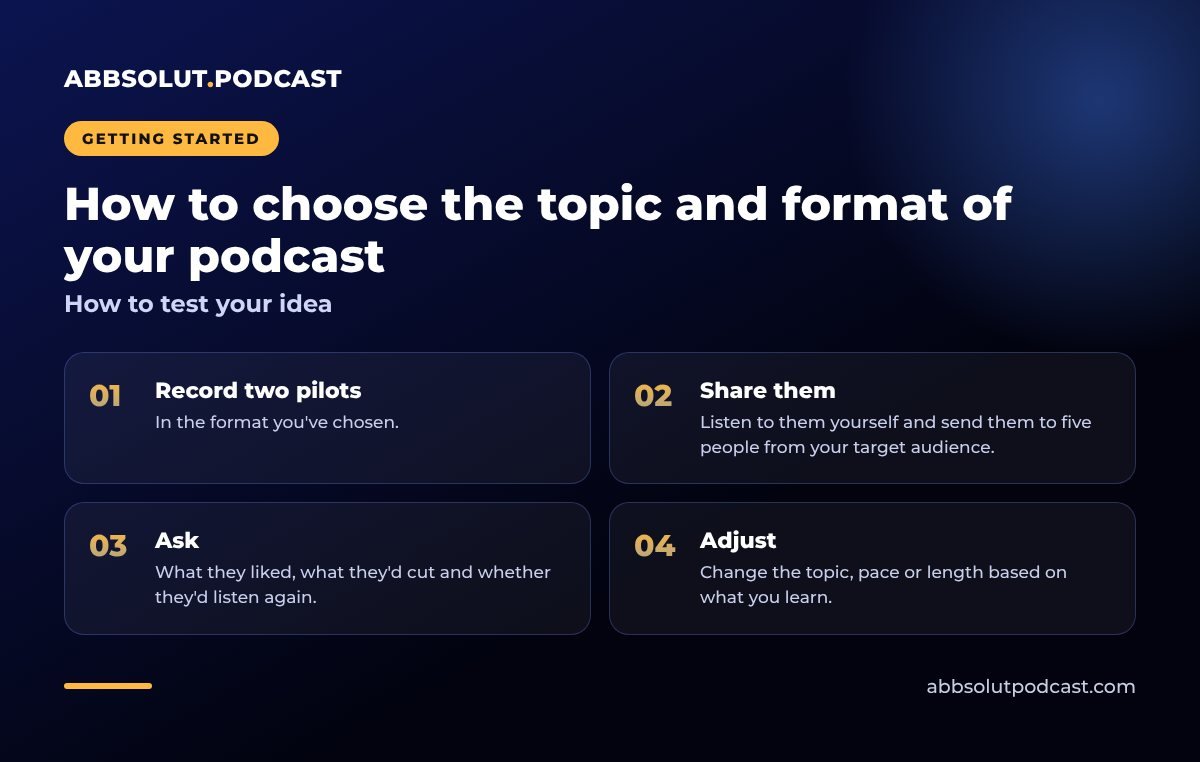
How to test your idea
- 01
Record two pilots
In the format you've chosen.
- 02
Share them
Listen to them yourself and send them to five people from your target audience.
- 03
Ask
What they liked, what they'd cut and whether they'd listen again.
- 04
Adjust
Change the topic, pace or length based on what you learn.
This small exercise saves you months of work in the wrong direction. If all five say the same thing, take note: it's the most useful signal you'll get before publishing.
Common mistakes when choosing
We give these warnings in almost every project we start:
- Copying a format because it works for someone else. What's natural in a comedy podcast can sound forced in a technical one. Adapt, don't copy.
- Choosing a niche with no audience. A specific topic is fine, but check that people are already asking those questions.
- Making episodes too long. If you can't keep up with the editing, the podcast suffers. Start short and make them longer once you've got the hang of it.
- Not thinking about continuity. Write a list of twenty episode ideas. If you struggle to reach ten, the topic is probably too narrow.
Match the format to your goal
If you're after brand visibility, conversations and interviews with well-known guests broaden your reach. If you want to educate your community, short, practical episodes work better.
If your purpose is corporate communication, see our guide to corporate podcasts.
📌 The key idea
The format isn't set in stone. Many shows evolve after the first season by listening to their audience.
And if you're torn between audio and video, think about where your audience is. Some projects gain a lot from adding video, as we explain in what a video podcast is and when it makes sense.
In short
A specific topic, a clear audience and a format you're comfortable with. Test with pilots, measure, adjust and choose a frequency you can sustain.
🎙️ How we do it at Abbsolut
Want help shaping your show? On our podcast production company in Barcelona page, we explain how we work.
Would you like us to produce your podcast?
We're a podcast production company in Barcelona. Tell us your idea and we'll send you a no-obligation proposal.
Get a quote