Explaining something complex clearly, without bending the truth, is an art. Podcasts are the ideal medium: you can explain things calmly, give specialists a voice and keep listeners company while they walk, drive or cook. At Abbsolut Podcast we especially love making science and culture accessible, so here's how to approach a show like this.
⚡ In 30 seconds
- Start with a question people have wondered about at some point.
- Rigour is your currency: sources, review and corrections.
- Short sentences, examples and analogies: explaining well isn't dumbing down.
- Tell each episode as a story, with a hook and an ending.
Why do podcasts work so well for sharing knowledge?
Five advantages
Time
An episode can explore an idea in depth, which is impossible on social media.
Voice
Intonation conveys enthusiasm, doubt and emotion.
Intimacy
Listeners feel part of a conversation and stop worrying about "not understanding".
Access
You can listen anywhere, no screen needed.
Longevity
A timeless topic keeps attracting listeners for years.
Before recording: define your approach
Who you're talking to. Explaining things to the general public isn't the same as explaining them to students or professionals in another field. Decide what you can assume people know and what needs explaining. A classic mistake: talking to colleagues when you meant to reach outsiders.

Which question you're answering. Good episodes start from an everyday question: why do we sleep? How was a cathedral built? Where do the words we use come from? The question sparks curiosity and gives you a structure: set-up, exploration and answer.
Start with the question, not the data.
Formats to mix
- Narrated monologue. A single voice guides the listener, with a carefully crafted script and edit.
- Interviews with specialists. They bring authority and a variety of voices. Learn how to prepare one in how to prepare a podcast interview.
- Two-person conversation. One explains and the other asks questions as the audience would.
- Short episodes. Five- to ten-minute bites on a single idea.
- Narrative documentary. With music, archive material and ambient sound.
You'll find more ideas in how to choose the topic and format.
Rigour: the basis of trust
Educational content lives or dies by its credibility. To keep it:
- Cross-check your sources. Recognised publications, institutions and specialists.
- Cite where each fact comes from, in the episode or in the show notes.
- Separate what is known from what is still debated.
- Ask an expert to review the script, especially if the topic isn't your speciality.
- Correct mistakes publicly. A note or a correction episode builds trust.
📌 The key idea
Acknowledging uncertainty gives you more authority, not less.
Clear language without oversimplifying
Explaining well isn't dumbing down. Some techniques:
- One idea per sentence. Clear subject and verb.
- Examples and analogies. Compare the unfamiliar with something everyday.
- Define technical terms the first time they appear, or avoid them if they don't add anything.
- Go from simple to complex.
- Repeat the essentials in other words: with audio, listeners can't go back and reread.
- Use figures sparingly and give them context: "twice as much" or "one in four" is easier to grasp than a decimal.
The art of storytelling
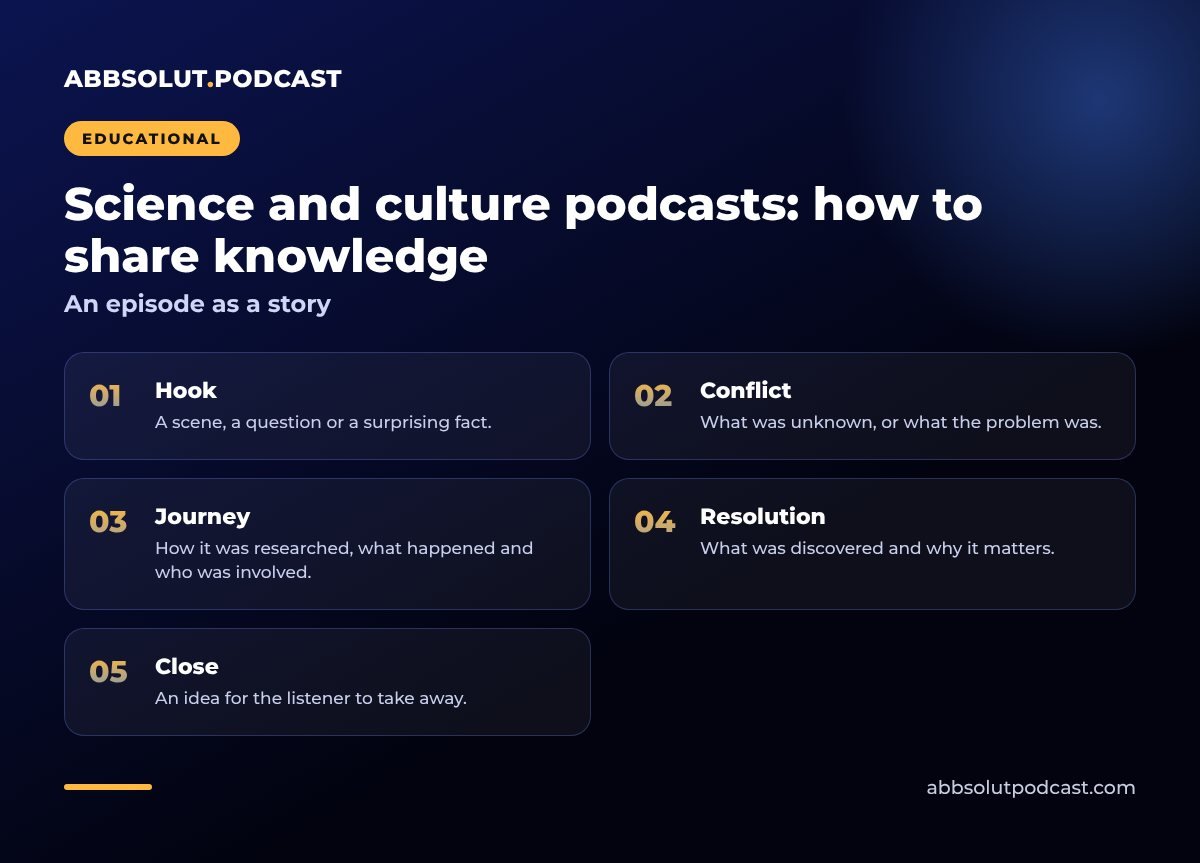
Science and culture are full of stories: accidental discoveries, stubborn characters, disputes and breakthroughs. Structure your episode as a story.
An episode as a story
- 01
Hook
A scene, a question or a surprising fact.
- 02
Conflict
What was unknown, or what the problem was.
- 03
Journey
How it was researched, what happened and who was involved.
- 04
Resolution
What was discovered and why it matters.
- 05
Close
An idea for the listener to take away.
Work on your script using script and structure of an episode. And pay attention to your delivery: your voice is your main tool. If you find it hard to loosen up, read overcoming your fear of the microphone and the camera.
Sound tells the story too
A cultural show benefits from careful production: a clear voice, music that doesn't drown it out and ambient sound that sets the scene. An archive recording or the sound of a place can say as much as an explanation.
💡 Tip
See how to edit a podcast and music and stingers to avoid copyright problems with the material you use.
From audio to video
Many scientific and cultural conversations benefit from visuals: a gesture, a museum piece, an experiment or a map. A video podcast lets you show them and produces clips that bring the topic to new audiences. Find out whether it's right for you in what is a video podcast.
⚠️ Common mistakes
- Starting with the data instead of the question.
- Throwing in jargon without explaining it.
- Sacrificing accuracy for clarity.
- Recording with poor acoustics: long explanations become tiring if there's echo. See recording a podcast at home.
- Not being consistent: a fixed schedule builds a habit.
Sharing knowledge as an institution or brand
Museums, universities, foundations, publishers and research centres have a lot to share but rarely have their own channel. A well-produced podcast lets them reach people who would never visit the institution. If that's you, at Abbsolut Podcast we get it, because this is our home ground.
In short
A good question, rigour, clear language and a well-built story. With those, any topic can grab people's attention.
🎙️ How we do it at Abbsolut
If you have a science or culture project and want it produced to a professional standard, tell us about it. We're a podcast production company in Barcelona.
Would you like us to produce your podcast?
We're a podcast production company in Barcelona. Tell us your idea and we'll send you a no-obligation proposal.
Get a quote