You don't need a studio for your podcast to sound good. Many successful shows are recorded in a living room, a wardrobe or a bedroom. What makes the difference is understanding how sound behaves in a room and knowing how to control it.
⚡ In 30 seconds
- Choose a room with soft materials that absorb sound.
- Do the clap test to detect echo.
- Cut out noise and work on your vocal technique.
- Set levels without clipping and always back up.
Choose the right room
Not all rooms sound the same. The worst are those with bare walls, hard floors and lots of glass, like kitchens and bathrooms. Sound bounces around and you get that metallic echo that gives away a home recording.
Look for a small or medium-sized room with things that absorb sound: thick curtains, rugs, a sofa, bookshelves, fabric wall hangings. The more soft, uneven objects, the fewer reflections.
🎯 Example
A bedroom with a wardrobe and a bed usually works brilliantly.
Test for echo with a clap
First of all, test the room. Clap loudly in the middle and listen. If you hear a metallic ring or a tail that takes a while to fade, there's reverberation and you've got work to do. If the sound dies away almost instantly, you've found a good spot.
Another test: record ten seconds of yourself talking and listen back on headphones. It's the quickest and most honest way to find out what your microphone is really picking up.
Treat the sound without breaking the bank
Even with limited resources you can make a big improvement:
Low-cost tips
Blankets or duvets
Hang them behind you and to the sides, especially if you have bare walls.
Rug
Place it under the desk to reduce reflections from the floor.
Bookshelves
Acts as a natural sound diffuser.
Wardrobe
Record among the hanging clothes. A classic trick that works better than you might think.
Acoustic panels
Effective if you want to go further, but not essential to start with.
Dense material
You need something porous and dense, not cardboard.
⚠️ Watch out for this
Watch out for materials that only insulate: egg boxes or cardboard absorb next to nothing.
Control the noise
Good audio is, above all, audio free of distracting noise.
Before you hit record
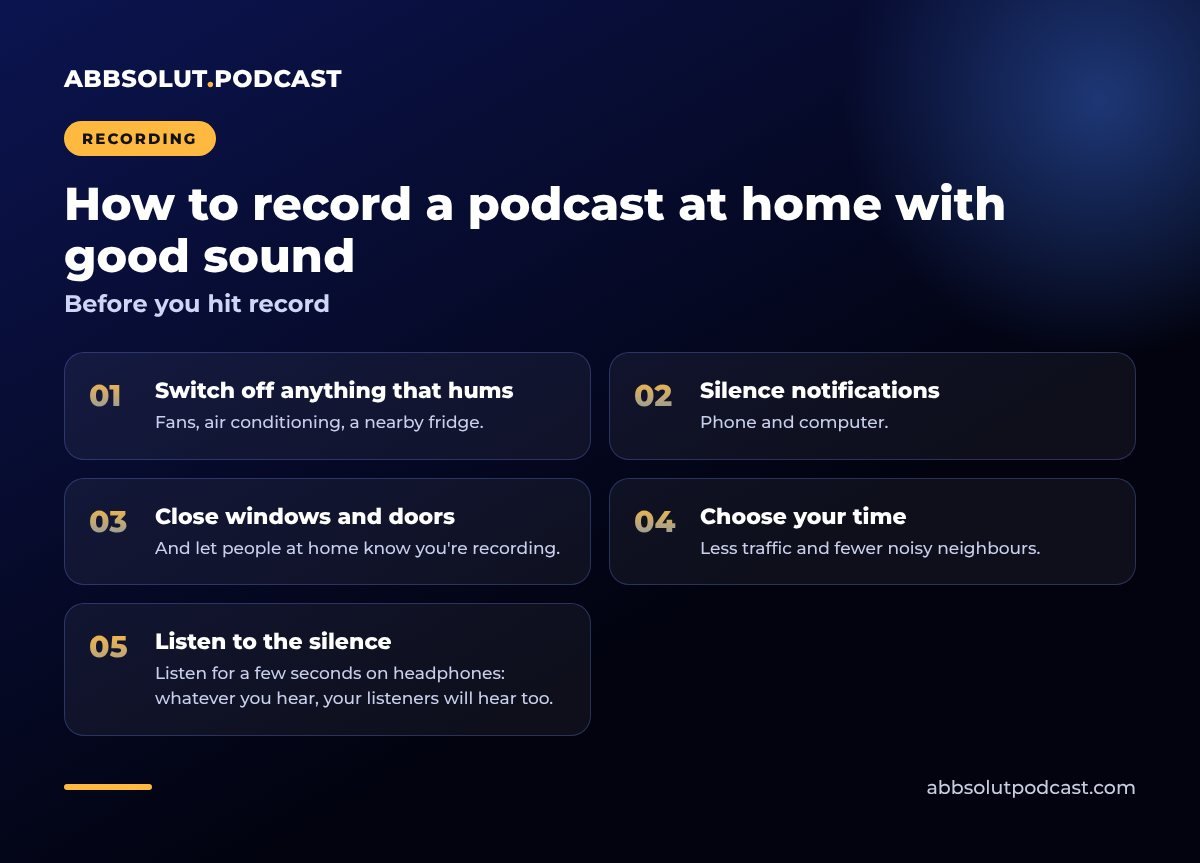
- 01
Switch off anything that hums
Fans, air conditioning, a nearby fridge.
- 02
Silence notifications
Phone and computer.
- 03
Close windows and doors
And let people at home know you're recording.
- 04
Choose your time
Less traffic and fewer noisy neighbours.
- 05
Listen to the silence
Listen for a few seconds on headphones: whatever you hear, your listeners will hear too.
Work on your technique
Your voice matters too. Even a good microphone sounds bad if the speaker keeps moving towards and away from it.
- Keep a steady distance of ten to fifteen centimetres.
- Speak slightly off to the side to avoid puffs of air.
- Stay hydrated: a glass of room-temperature water helps avoid mouth clicks.
- Speak with energy, as if someone were sitting opposite you. When you record alone, it's easy to sound flat.
Speak as if someone were sitting opposite you.
If you struggle to sound natural in front of the microphone, read how to overcome your fear of the microphone and camera.
Set your levels
In your recording software, set the gain so that your voice peaks at roughly half to three quarters of the meter, without ever hitting the red.
📌 The key idea
It's better to record slightly low than to clip: clipping can't be fixed afterwards.
Do a thirty-second test, speaking as you would in the episode, with a laugh or some emphasis thrown in. That way you can check your real range. If you use the equipment we recommend in what equipment you need to record a podcast, you won't have any problems.
Common mistakes when recording at home
- Computer right next to the microphone. The fan noise creeps into the recording. Move it further away or use a longer cable.
- Sitting facing a bare wall. It's better to have a curtain, bookshelf or wardrobe behind you.
- Changing position mid-episode. Moving changes the volume and tone. Find a comfortable, stable posture.
- Not listening back to the recording. Always check the first few minutes before carrying on.
Backups and when to record elsewhere
Save your recordings somewhere safe with a clear file name: date and episode number. Keep a copy on a second drive or in the cloud. Few things hurt more than losing an episode to a computer crash.
If your episodes are guest interviews, you need to record video or your brand demands very high quality, it may be worth recording outside your home. A production company can bring the equipment to you or find a suitable studio. We cover the options in how to choose a podcast production company in Barcelona.
In short
The right room, soft furnishings, no background noise, good technique and properly set levels. With these, your home podcast can sound like it was recorded in a studio.
🎙️ How we do it at Abbsolut
If you'd rather hand it over, Abbsolut Podcast can record in your space or find the right one for you. Find out more about our podcast production company in Barcelona.
Would you like us to produce your podcast?
We're a podcast production company in Barcelona. Tell us your idea and we'll send you a no-obligation proposal.
Get a quote