A good interview isn't a list of questions: it's a conversation with a purpose. When it works, the guest opens up and the listener learns something. When it fails, it sounds like an interrogation. The difference almost always lies in the preparation.
⚡ In 30 seconds
- Choose guests who have something to say, not just a big name.
- Do your research and write open questions, one at a time.
- Listen more than you talk and leave silences.
- Look after the sound and end with a memorable question.
Who should you invite?
A famous guest doesn't guarantee a good episode. What matters is that they have something to say, can explain it well and are relevant to your audience. Before you get in touch, ask yourself:

- What will my listener learn from this conversation?
- Can they explain things well, or will they give one-word answers?
- Do they have a story, an experience or an opinion of their own?
If you can, watch one of their previous appearances. It'll show you how they talk and which topics they're passionate about.
Research before you ask
Spend some time looking into their career, publications and previous interviews. That way you'll avoid questions they've answered a thousand times and find fresh angles.
What to put in your notes
Milestones
The moments that define their career.
Recurring ideas
What they say everywhere, which you can explore in more depth.
Little-known detail
The detail that opens the door to a more personal conversation.
Your guest will appreciate that you've done your homework. And you'll feel more confident: when you know someone's background, it's much easier to come up with a good question on the spot.
A tip: keep your notes on a single page rather than in twenty open tabs. You won't have time to look anything up during the recording, and you can glance at one page without losing track of what the other person is saying.
How to write good questions
A few simple rules make a big difference.
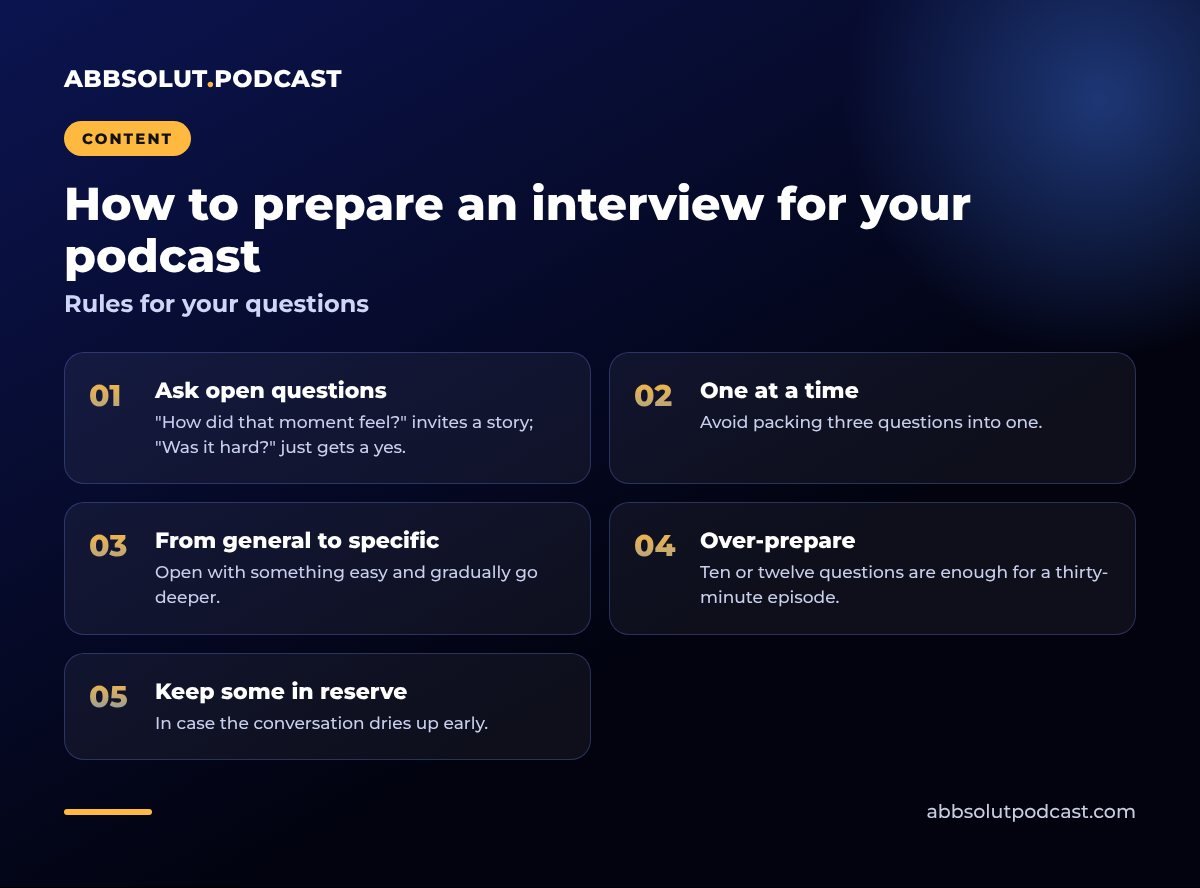
Rules for your questions
- 01
Ask open questions
"How did that moment feel?" invites a story; "Was it hard?" just gets a yes.
- 02
One at a time
Avoid packing three questions into one.
- 03
From general to specific
Open with something easy and gradually go deeper.
- 04
Over-prepare
Ten or twelve questions are enough for a thirty-minute episode.
- 05
Keep some in reserve
In case the conversation dries up early.
The guest is the star; you're the one who makes them shine.
Send an outline in advance, but keep it flexible
Share the main topics and roughly how long it will take, not every question. That way they'll come prepared without sounding rehearsed. Explain how the recording will work: if it's remote, which tool you'll use, and that they should wear headphones and find a quiet space.
💡 If it's their first time
Tell them they can redo any answer and that it will be edited afterwards. That really helps with nerves. For the rest of the episode, see our guide to scripts and structure.
Get the sound right and lead calmly
Nothing ruins an interview like bad audio. In person, position the microphones so you can both hear each other comfortably. When recording remotely, record each voice separately whenever you can.
⚠️ Watch out for this
Do a one-minute sound check before you start. Five minutes spent on this can save you from losing a valuable interview. If you need to check your kit, see what equipment you need to record a podcast.
During the conversation, your role is to listen.
- Listen properly. The best questions come from what the guest has just said.
- Leave silences. Waiting an extra two seconds brings out the most interesting answers.
- Ask for examples. "Can you tell us about a specific case?" turns an abstract idea into a story.
- Steer back gently. If they go off on a tangent: "Going back to what you were saying earlier…".
🎯 Example
A shy guest needs warm questions and time to settle in. A very talkative one appreciates short, direct questions that set the pace. Watch the first few minutes and adjust how you lead.
End on a high
Listeners remember the last few minutes. Don't let the conversation fizzle out: signal that you're wrapping up and save your best question for last.
End with a memorable question, such as "What advice would you give someone starting out?" or "What would you like listeners to take away today?". Then ask the guest to tell people where they can find them.
Thank them for their time and let them know when the episode will go out. When it's live, send them links and clips for social media: the more people share it, the further it reaches. You'll find ideas in how to promote your podcast on social media.
✅ Mistakes to avoid
- Reading out questions without listening to the answers.
- Constantly interrupting.
- Talking more than the guest.
- Not editing: good editing removes filler words and long pauses while keeping things natural, as we explain in how to edit a podcast.
In short
Choose guests with a story, research, ask open questions, look after the sound and listen. With practice, interviews will become the heart of your show.
Interviewing at an event, with little time and lots of noise? You'll find specific tips in podcasts at events and conferences.
🎙️ How we do it at Abbsolut
If you need help producing your interviews, Abbsolut Podcast can support you every step of the way. We're a podcast production company in Barcelona and take care of recording, editing and publishing.
Would you like us to produce your podcast?
We're a podcast production company in Barcelona. Tell us your idea and we'll send you a no-obligation proposal.
Get a quote