Publishing an episode is only half the job. The other half is making sure people find it. And you won't get there by repeating "the new episode is out now", but by offering a taste so good that people want to hear the rest.
⚡ In 30 seconds
- Each episode becomes clips, quotes, carousels and articles.
- Pick two platforms and do them well, rather than giving up on five.
- A good clip hooks in the first three seconds and has subtitles.
- Measure retention and clicks, not just likes.
Who are you talking to?
Before publishing, define your ideal listener: what interests them, which platform they spend time on and what formats they consume. A podcast for executives will fit better on LinkedIn; one about humour or pop culture, on Instagram or TikTok.

You don't need to be everywhere. Two well-run platforms beat five neglected ones.
One episode, many pieces
A forty-minute episode is a goldmine. Here's how to make the most of it:
Six pieces per episode
Vertical clips
Thirty- to ninety-second excerpts featuring the most interesting, surprising or useful moments.
Audiograms
If you only record audio, a video with a waveform, artwork and subtitles works on any platform.
Quote graphics
A powerful line on a background that matches your visual identity.
Carousels
The episode's five key points in slide format.
Stories
A question or poll related to the topic.
Articles
A post on your blog or LinkedIn that summarises and links to the episode.
Recording on video makes this much easier, because every conversation gives you footage ready to cut. If you're unsure, read what a video podcast is.
How to make a clip that works
A clip lives or dies in the first few seconds. Nobody waits for you to finish the introduction.
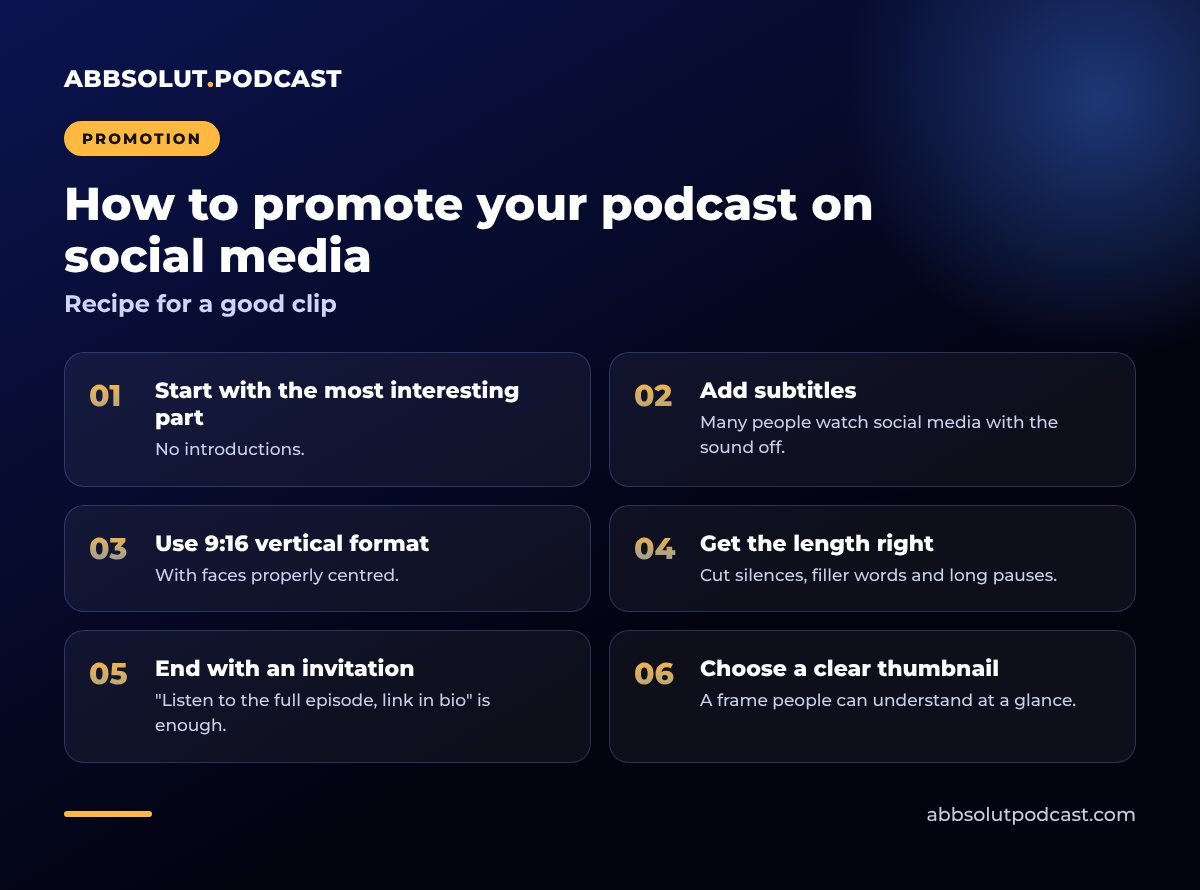
Recipe for a good clip
- 01
Start with the most interesting part
No introductions.
- 02
Add subtitles
Many people watch social media with the sound off.
- 03
Use 9:16 vertical format
With faces properly centred.
- 04
Get the length right
Cut silences, filler words and long pauses.
- 05
End with an invitation
"Listen to the full episode, link in bio" is enough.
- 06
Choose a clear thumbnail
A frame people can understand at a glance.
A good guest produces clips that share themselves.
The quality of the conversation matters a lot. Take another look at how to prepare a podcast interview.
A schedule you can sustain
Consistency beats intensity. Here's a realistic plan for each episode:
| When | What you publish |
|---|---|
| Before release | An announcement with a short teaser |
| Release day | The strongest clip and the link to the episode |
| The following week | Two or three clips, a quote and a genuinely useful post |
| In the weeks after | A new clip from earlier episodes |
Good content can be used more than once. Prepare several pieces in one go and schedule them, so you're not relying on daily inspiration.
💡 Tip
Set aside one session a month to prepare and schedule everything. It takes less time than deciding what to post every morning.
Guests and collaborations
Guests are your best ambassadors. Send them the clip and link, tag them and ask them to share it.
Collaborate with shows on similar topics too: swap mentions, appear on their episodes or record one together. Listeners of a like-minded podcast are the most receptive audience for yours.
Look after your profile and make the episode easy to find
Your bio is your business card. Say what the podcast is, who it's for and link to a page with all the platforms. Use the same artwork, colours and tone everywhere. If you haven't got round to this yet, see how to choose your name and artwork.
✅ Before publishing
- A single visible link that leads to every platform
- A play button or a page on your website
- A single call to action per post
- Subtitles and a hook in the first few seconds
To be on every platform, read how to publish your podcast on Spotify, Apple Podcasts and iVoox.
What to measure (and what to ignore)
It's easy to obsess over likes. Focus instead on:
- Video retention: how much of it people watch before dropping off.
- Clicks on the link in your bio.
- Downloads or plays that come in after a post.
- New subscribers and comments.
- Which clips work, so you can repeat that type of content.
Review the data once a month. If clips with practical tips perform better than anecdotes, make more of them.
⚠️ Common mistakes
- Posting only links: platforms reward native content.
- Not adapting the format: what works on LinkedIn may not work on TikTok.
- Giving up after two weeks: results come with time.
- Ignoring comments: replying builds community.
What if you don't have time?
Cutting, subtitling and scheduling takes hours. If your time is better spent elsewhere, at Abbsolut Podcast we create reels, TikToks and clips from your episodes. Find out more in reels, TikToks and short documentaries.
In short
Turn each episode into several pieces, nail the hook, keep a realistic schedule and measure what works. It takes consistency, not one big push.
As well as social media, more and more listeners discover podcasts by asking ChatGPT or Perplexity. Find out how to make your podcast appear in AI search engines.
Events are a goldmine of clips: in one day you can record weeks' worth of content. See how to make the most of an event or conference with a podcast.
🎙️ How we do it at Abbsolut
If you're looking for a team to handle both recording and promotion, take a look at our podcast production company in Barcelona. Tell us what you want to achieve.
Would you like us to produce your podcast?
We're a podcast production company in Barcelona. Tell us your idea and we'll send you a no-obligation proposal.
Get a quote