More and more people aren't searching on Google: they're asking ChatGPT, Perplexity or Gemini, or reading the AI summary at the top of the results. If someone asks "Which podcast would you recommend about leadership?" or "Who talks about sports nutrition in Spanish?", does yours come up? The good news is that it doesn't take magic. Your podcast just needs to exist as text too: well organised and easy to cite.
⚡ In 30 seconds
- AI search engines read text: without a transcript, your episode is almost invisible.
- Give each episode its own page on your website, with a summary, chapters and transcript.
- Clear titles that answer real questions beat "Episode 23".
- YouTube with subtitles and chapters multiplies your chances of being cited.
- Check that your website doesn't block AI crawlers.
What are AI search engines?
Instead of giving you a list of links, these tools give you a written answer and cite the sources they used. The most popular right now are ChatGPT with search, Perplexity, Gemini, Copilot and Google's AI Overviews.
To answer, they crawl the web just like a traditional search engine, pick the pages that best answer the question and link to them. If your podcast is one of those sources, the AI recommends it by name, with a direct link. This is sometimes called GEO (generative engine optimisation), although at heart it's just good old-fashioned SEO with a few tweaks.
AI doesn't listen: it reads
This is the key point. Although AI can already understand audio, search engines almost always work with text. To them, an hour of brilliant conversation uploaded only to Spotify is just a title and two lines of description.
What AI can read from your podcast
Transcript
The full episode as text, proofread, with names spelled correctly.
Summary
A paragraph saying what the episode is about and what listeners will learn.
Chapters
Timestamps with descriptive titles: "02:15 Choosing a microphone".
Guest profile
Name, job title and what they do, linked to their website or profile.
Subtitles
On YouTube and in social media clips. These get indexed too.
Resources mentioned
Books, studies and links mentioned in the conversation.
Automatic transcripts are a good starting point, but check them: a misspelt name or a garbled sentence undermines your credibility, and AI prefers clean sources.
One page per episode
Audio platforms are shop windows, but you don't own or control them. You do own your website. Ideally, each episode should have its own page, with a clear URL and all its content as text.
How to build an episode page
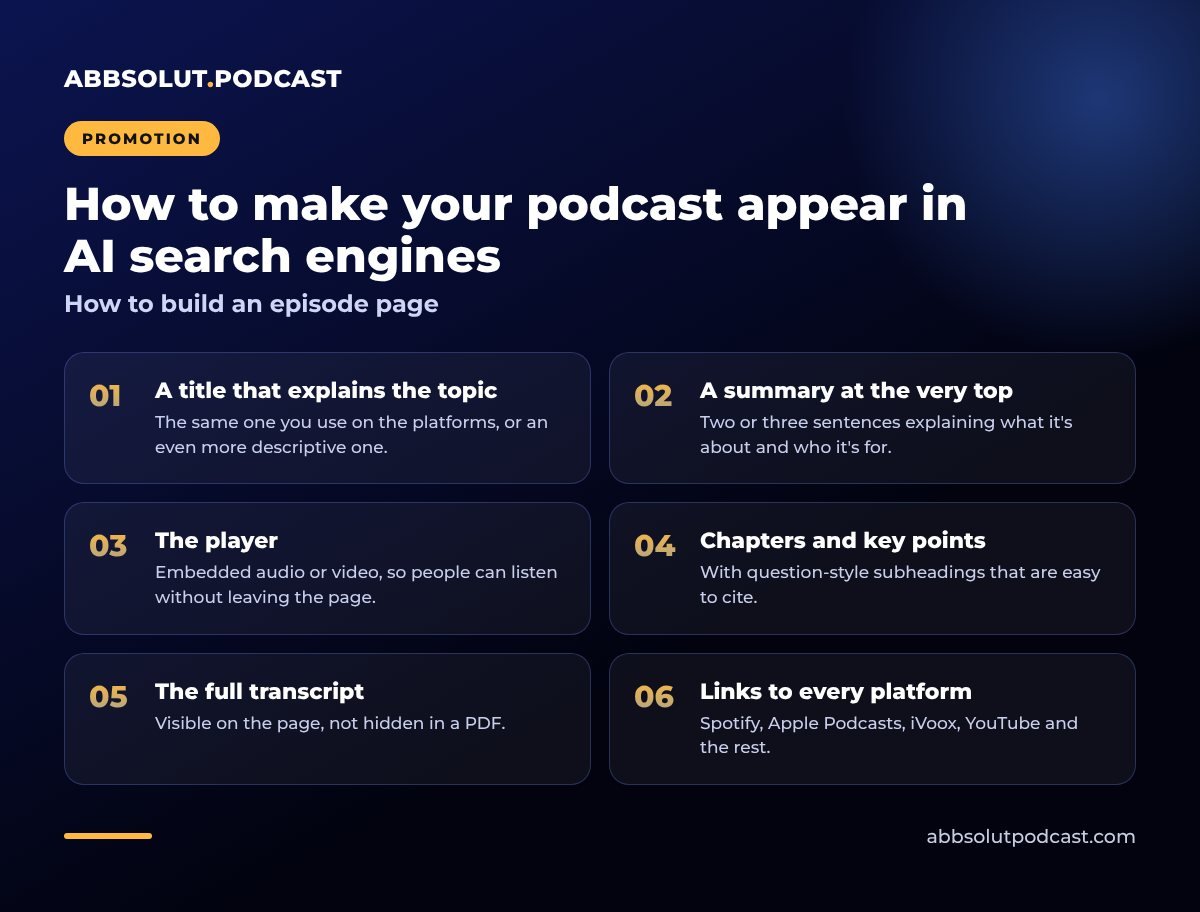
- 01
A title that explains the topic
The same one you use on the platforms, or an even more descriptive one.
- 02
A summary at the very top
Two or three sentences explaining what it's about and who it's for.
- 03
The player
Embedded audio or video, so people can listen without leaving the page.
- 04
Chapters and key points
With question-style subheadings that are easy to cite.
- 05
The full transcript
Visible on the page, not hidden in a PDF.
- 06
Links to every platform
Spotify, Apple Podcasts, iVoox, YouTube and the rest.
If your website supports it, add PodcastEpisode and PodcastSeries structured data (schema.org). This helps search engines understand that the page is an episode, which show it belongs to and who takes part.
💡 Tip
You don't need to transcribe your entire back catalogue at once. Start with the five episodes that best answer your audience's most common questions and add a new one each week.
Titles and descriptions that answer questions
People talk to AI as they would to a person: in full questions. The closer your titles and descriptions are to those questions, the more likely the AI is to choose you as a source.
| Don't | Do |
|---|---|
| Episode 23 with Laura | How to negotiate a pay rise, with employment lawyer Laura Pérez |
| Chatting about this and that | What to eat before running a marathon: mistakes and myths |
| Summer special | Five Costa Brava destinations for travelling with children |
A good episode structure makes this much easier, because each section already answers a question. We explain how in how to structure a podcast episode. And if you're still deciding on a name, have a look at how to choose your podcast's name and artwork: a name that says what the podcast is about helps AI too.
AI doesn't recommend the best-sounding podcast; it recommends the one that explains itself best.
YouTube, your best ally
YouTube is one of the most frequently cited sources in AI answers, especially Google's. And it has a huge advantage: it generates subtitles that can be read and indexed.
- Upload the full episode, even if it's just over a still image; video is even better.
- Check the automatic subtitles or upload your own.
- Add chapters with timestamps in the description.
- Write a full description, with the summary and links.
- Publish short clips that each answer a single question.
If you don't record on video yet, it's worth reading what a video podcast is and when to make the jump. And for clips, you'll find ideas in how to promote your podcast on social media.
Let the crawlers in
It sounds obvious, but it happens a lot: websites accidentally block the bots that AI tools use to search. Check these points with whoever manages your website:
✅ Quick technical check
- The robots.txt file doesn't block Googlebot, Bingbot, OAI-SearchBot (ChatGPT) or PerplexityBot
- Episode pages appear in the sitemap
- The transcript is in the page's HTML, not loaded by JavaScript alone
- The website loads fast and looks good on mobile
- Your RSS feed is public and has full descriptions
The feed matters too: many platforms and directories pull from it. If you're not sure how it works, read what an RSS feed is and how to choose hosting, and make sure you're listed everywhere by following how to publish your podcast on Spotify, Apple Podcasts and iVoox.
Authority and mentions
AI tools prefer sources they can trust. And online, trust is built through consistency and what others say about you.
- Use the same name and description for the podcast on your website, platforms and social media.
- Explain who's behind it: an "about us" page with a real track record.
- Get mentioned: ask your guests to link to the episode from their websites, and appear on other podcasts, in the media and in industry lists.
- Publish consistently: an active archive comes across as more reliable than an abandoned one.
⚠️ Common mistakes
- Publishing only the audio, with no accompanying text.
- Generic or numbered titles that don't say what the episode is about.
- Automatic transcripts full of mistakes that nobody has checked.
- Blocking AI crawlers without realising it.
- Podcast information scattered around under different names.
How to tell if it's working
There's no perfect tool yet, but there are some clear signs:
- Ask AI tools what your ideal listener would ask, and note whether they cite you.
- Check your website analytics: visits from chatgpt.com, perplexity.ai or gemini.google.com appear as referrals.
- Keep an eye on Search Console: if your episode pages are gaining impressions, you're on the right track.
- Ask new listeners how they found you.
Do this once a month and compare. Changes aren't instant, but they add up.
🎙️ How we do it at Abbsolut
When we produce a podcast, we don't stop at the audio: we prepare titles, descriptions, chapters and transcripts, publish it on Spotify, Apple Podcasts, iVoox, YouTube and other digital platforms, and turn it into clips. Find out more about our work as a podcast production company in Barcelona and our video podcast service.
In short
To get your podcast into AI search engines, turn it into text: one page per episode, titles that answer questions, proofread transcripts, YouTube with subtitles and a website that lets crawlers in. If you're just starting out, build on that foundation from your very first episode by following how to start a podcast from scratch.
Want your podcast to be found?
We're a podcast production company in Barcelona. Tell us your idea and we'll send you a no-obligation proposal.
Get a quote