You've finished editing, but the episode isn't ready yet. It still needs the processing that makes the voice sound present, clear and consistent in volume on any device. It's called mixing and mastering, and it sounds harder than it is.
⚡ In 30 seconds
- Mixing balances voices, music and effects; mastering polishes the final result.
- EQ with small changes and compress gently.
- Aim for around -16 LUFS in stereo.
- Always listen on several devices.
Mixing and mastering: what's the difference?
Two steps, two goals
Mixing
Balancing voices, music, effects and silences: volume, tone and space so that everything comes through clearly.
Mastering
A final polish of the whole thing: overall loudness and meeting platform standards.
In podcasting they're often done together, especially in simple productions. Even so, it's worth understanding the difference so you know what needs doing at each stage.
Think of it like cooking: mixing is balancing the ingredients in the dish, and mastering is plating it up and making sure it looks just as good on any table. Flavour first, presentation second. If you do it the other way round, you'll end up polishing something that isn't balanced yet.
EQ: clarity for your voice
EQ means boosting or cutting frequencies. For spoken voice:
- Cut unnecessary low end. A high-pass filter at around eighty to a hundred hertz removes rumble and desk knocks.
- Reduce muddiness. Too much around two to three hundred hertz makes a voice sound "boxy".
- Add presence. A small boost between two and four kilohertz makes the voice easier to understand.
- Tame sibilance. If the "s" sounds are harsh, a de-esser softens them.
⚠️ Watch out for this
If you find yourself doing a lot of EQ, the problem probably lies in the recording. Fix it at the source.
Compression: a more even voice
The human voice varies a lot in volume. A compressor reduces the difference between loud and soft, so you can raise the overall level without clipping. To start with, use a low ratio and a threshold that only acts on the peaks.
Take it slowly: increase the effect, listen, and if the voice starts to lose life or the breaths sound exaggerated, go back a step. It's better to do too little than too much, because an over-compressed voice becomes tiring within minutes.
So you're just as clear whether you're whispering or laughing.
Final loudness: what LUFS are
LUFS measure loudness as the ear perceives it. They help all podcasts play at a similar level, so nobody has to adjust the volume between shows.
| Format | Typical target | Maximum peak |
|---|---|---|
| Stereo | Around -16 LUFS | Close to -1 dB |
| Mono | About -19 LUFS | Close to -1 dB |
Each platform has its own recommendations and they can change, so check them before setting your levels. Most audio software includes a LUFS meter or a normalisation feature.
The process, step by step
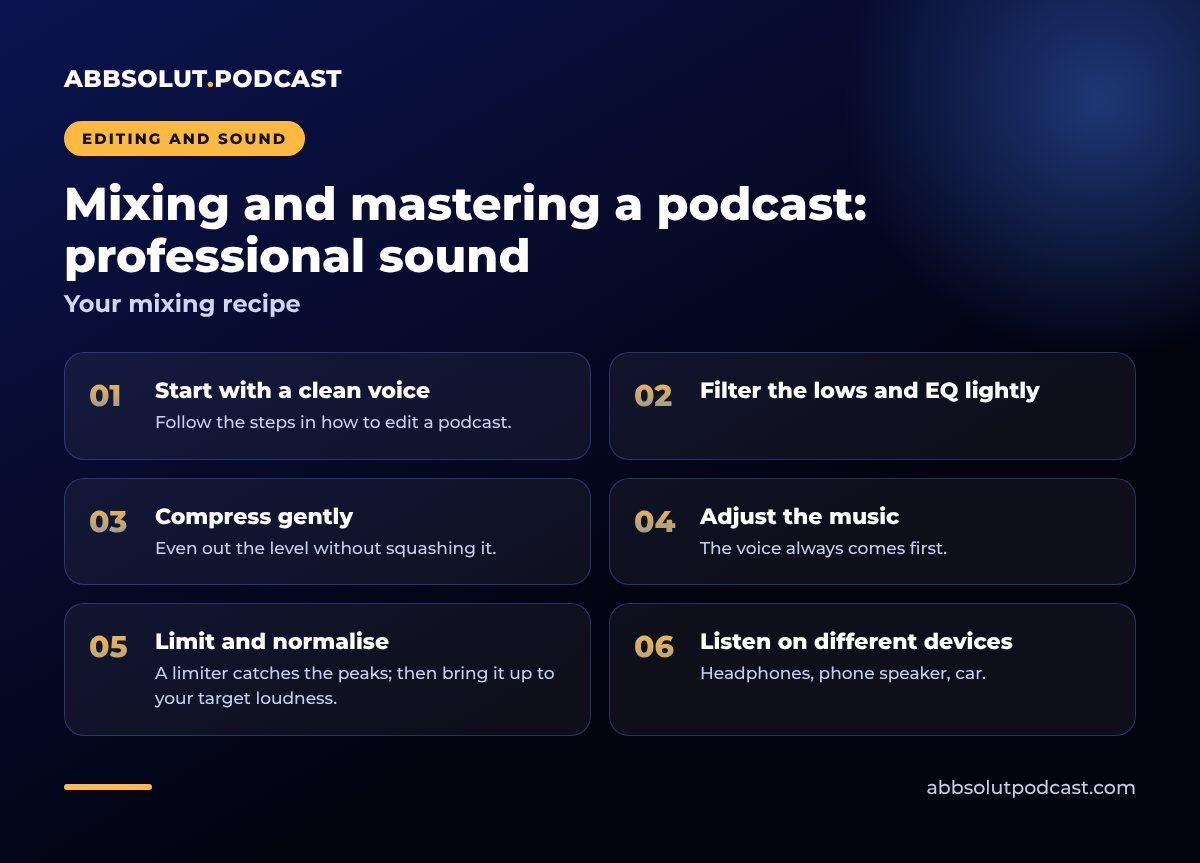
Your mixing recipe
- 01
Start with a clean voice
Follow the steps in how to edit a podcast.
- 02
Filter the lows and EQ lightly
- 03
Compress gently
Even out the level without squashing it.
- 04
Adjust the music
The voice always comes first.
- 05
Limit and normalise
A limiter catches the peaks; then bring it up to your target loudness.
- 06
Listen on different devices
Headphones, phone speaker, car.
That last step is essential. What sounds good on your headphones may sound thin on a small speaker, and that's where many people listen.
Common mistakes
- Chasing loudness at all costs. Very loud, heavily compressed audio is tiring to listen to.
- Trying to fix a bad recording with effects alone. They won't remove echo or heavy background noise. Start by recording properly in the first place.
- Different loudness in every episode. Always use the same target.
- Music that drowns out speech. Turn it down whenever someone is speaking.
💡 Final tip
Listen to the episode at low volume, as you would on public transport or while cooking. If you can still follow everything at that level and nothing gets lost, the mix is balanced. Repeat using a single phone speaker: it's the worst-case scenario and the most revealing.
Tools and professional help
You can mix well with free or paid tools. There are also automatic voice enhancement services that can help with simple productions, although it's best to check the results on headphones. What really matters is good judgement and a routine.
For the musical side of the episode, see music and stingers for your podcast.
If the podcast is for a brand, combines voices recorded in different conditions or needs a broadcast-quality finish, professional production brings quality and peace of mind. It's one of the stages where experience really shows.
In short
EQ gently, compress in moderation, match a target such as -16 LUFS and listen on several devices.
🎙️ How we do it at Abbsolut
If you need a hand, as a podcast production company in Barcelona we take care of the mix and the whole process, so your episode sounds good on any platform.
Would you like us to produce your podcast?
We're a podcast production company in Barcelona. Tell us your idea and we'll send you a no-obligation proposal.
Get a quote