More and more companies, from start-ups to large corporations, are launching their own podcast. It isn't a passing fad. Long-form audio and video give you something an ad can't: twenty or thirty minutes of conversation with your audience. That time builds trust, and trust is the basis of almost any sale.
⚡ In 30 seconds
- A corporate podcast serves a business goal; it doesn't sell directly.
- It works for clients, talent and internal communication.
- It needs a clear promise, good sound and regular episodes.
- It's measured by a qualified audience, not just downloads.
What is a corporate podcast?
It's a show produced by a company or organisation with a business goal: raising brand awareness, educating its market, building client loyalty, bringing the team together or attracting talent.

Unlike advertising, it doesn't sell directly. It offers information, stories or conversations that strengthen the relationship with listeners. It's also called a branded podcast, although there are subtle differences: a corporate podcast can be external-facing or for internal communication.
What's it for?
Six common uses
Positioning yourself as a leader
If you talk to experts in your industry every week, your brand becomes associated with that knowledge.
Building trust before the sale
Someone who has listened to you for weeks arrives at the sales meeting in a different frame of mind.
Opening doors
Inviting potential clients, suppliers or opinion leaders builds relationships that a cold email never could.
Internal communication
A show for employees about news, culture and people brings distributed teams together.
Attracting talent
Showing how things work on the inside strengthens your employer brand.
Reusing content
Each episode feeds your social media, newsletters and articles.
Your podcast isn't competing for a mass audience; it's competing for the attention of the right people.
Formats that work
- Interviews with experts or clients. The most common and the easiest to sustain.
- Internal conversations between executives, teams or professionals.
- Industry insight. Trends, regulations or news explained clearly.
- Success stories. Real client stories with concrete results.
- Narrative or documentary. More polished, with a script, music and careful editing.
- Training. Short episodes that teach people how to use a product or solve a problem.
You'll find more options in how to choose the topic and format.
How to go about it, step by step
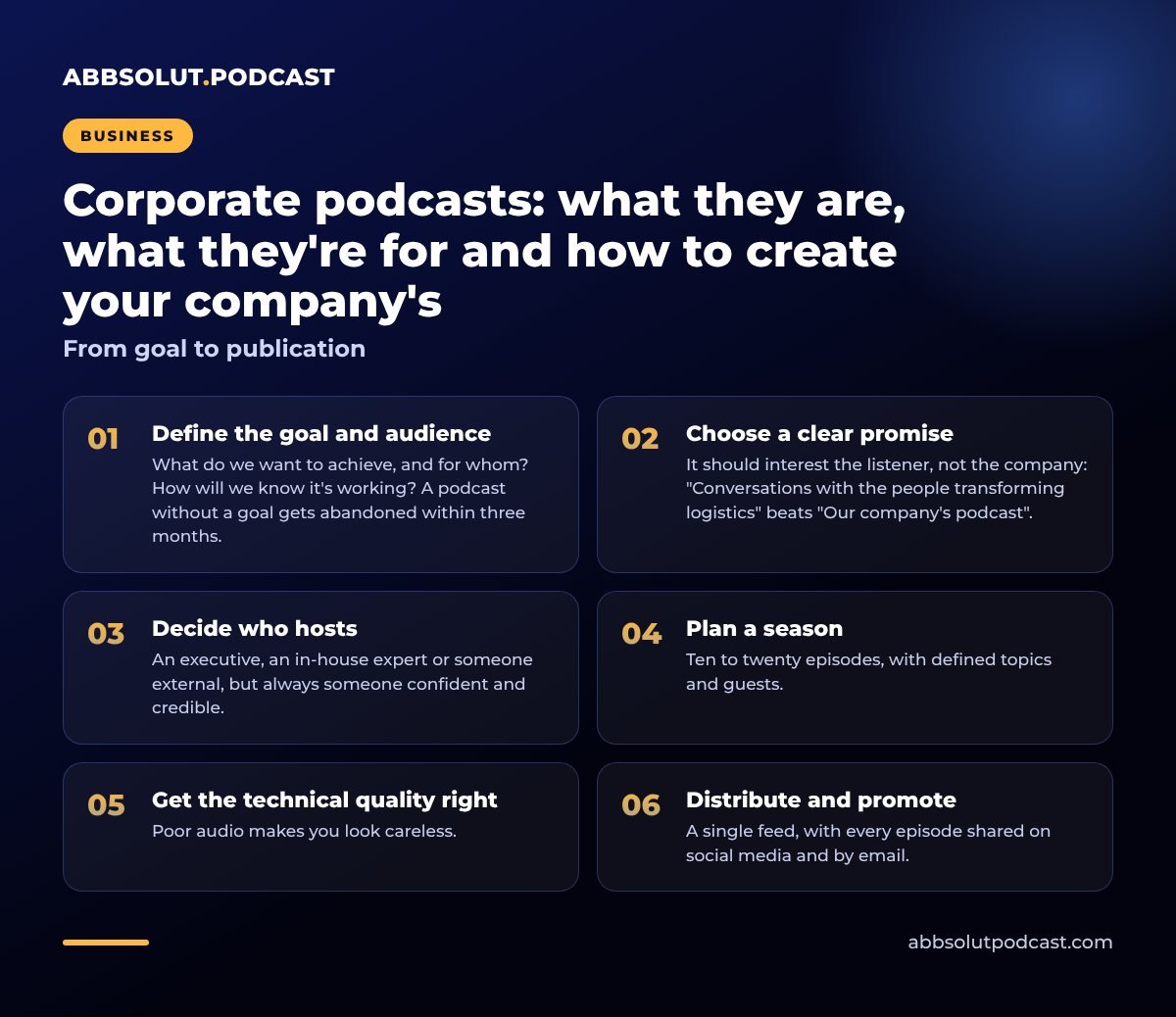
From goal to publication
- 01
Define the goal and audience
What do we want to achieve, and for whom? How will we know it's working? A podcast without a goal gets abandoned within three months.
- 02
Choose a clear promise
It should interest the listener, not the company: "Conversations with the people transforming logistics" beats "Our company's podcast".
- 03
Decide who hosts
An executive, an in-house expert or someone external, but always someone confident and credible.
- 04
Plan a season
Ten to twenty episodes, with defined topics and guests.
- 05
Get the technical quality right
Poor audio makes you look careless.
- 06
Distribute and promote
A single feed, with every episode shared on social media and by email.
If your team isn't comfortable in front of the microphone yet, a little training helps: read how to overcome your fear of the microphone and the camera.
For the script, follow script and structure of an episode. For sound, see the equipment you need and consider whether video adds anything, as explained in what is a video podcast.
Publishing is covered in how to publish your podcast, and promotion in how to promote your podcast on social media.
💡 Tip
Work in seasons. That way you keep things regular and can run a launch campaign.
What should you measure?
The number of downloads is only part of it. Also look at:
- Returning listeners and retention.
- Website visits from links in the show.
- Meetings or leads that mention the podcast.
- Guest participation and the reach of their communities.
- For internal communication, employee engagement and participation surveys.
A show with few downloads but a very well-targeted audience can still be a success.
Mistakes to avoid
⚠️ Watch out for this
- Talking about the company instead of talking to the listener. Nobody listens to a thirty-minute ad.
- Not keeping it going. Releasing three episodes and then disappearing does more harm than never starting.
- Relying on one person. Have stand-ins ready.
- Neglecting the sound. It's the first thing people notice.
- Giving away ownership. The accounts and feed must be in the company's name.
How much time does it take?
An interview episode involves preparation, recording, editing, publishing and promotion. Even if the episode is only thirty minutes long, the process can take several days.
That's why many companies prefer to work with a production company. To get an idea of the costs, see how much it costs to produce a podcast.
In short
A corporate podcast works when it has a clear goal, a useful promise, good sound and regularity.
A good way to start is to make the most of an industry event or conference: we explain how in podcasts at events and conferences.
🎙️ How we do it at Abbsolut
We design and produce shows for brands and companies, from idea to publication, and record at your office or wherever you need in Barcelona. Find out more about us as a podcast production company in Barcelona and tell us what you'd like to achieve.
Would you like us to produce your podcast?
We're a podcast production company in Barcelona. Tell us your idea and we'll send you a no-obligation proposal.
Get a quote